


Racing games exist in this sort of limbo within the industry where no one is really sure what makes one great. Is it the number of vehicles available to the player? The depth of their customizability? The vehicle handling? The maps? The story, if there even is one? And to which extent do any of these improve or detract from a racer? No one really knows.
And they shouldn’t know. For what they are at their core, racing games are actually a pretty diverse bunch, and each somehow finds a way to iterate in unique ways on what is, in every conceivable way, a very simple formula.
Star Wars: Galactic Racer is one such game, and while its core remains fundamentally the same as every game of this type, there is enough in it to draw you in and keep you there for a very long time.
Here is our full review.
A long time ago, in a galaxy far, far away…
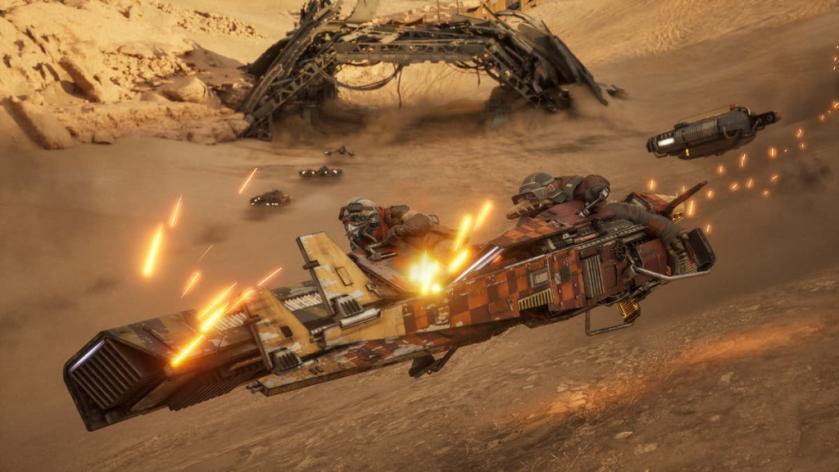
Star Wars: Galactic Racer, as the name itself indicates, is set in the Star Wars universe’s galaxy far, far away, across numerous original planets and featuring a bunch of new characters, all of which seem to be canon to the broader SW cosmology. You play as Shade, a custom character hailing from the planet of Gathleon, who was a slave to the Bool family – a powerful feudal house that took great advantage from the Empire to enrich itself on the backs of others.
Your character meets Kestar Bool, a legendary racer and nepobaby, and you must climb the ranks to defeat him. Things go awry and you end up having to qualify, then win the league, then win it again, and so on, and so forth. There isn’t too much to say about the story, really. It’s definitely there for the campaign mode and, actually, it’s surprisingly solid considering how small of a role it plays in the grand scheme of things.
The characters are all unique, there’s a bunch of recognizable environments and races (like the planet Crait) but overall everything is mostly original to the game itself. And it does play heavily into the broader Star Wars narrative, what with the fall of the Empire, the Rebellion’s victory, and how all of that affected each of the cast members. The story did take a few twists and turns that I did not expect and wound up providing me with quite a bit of satisfaction on that end. But, again, it’s not really the most important thing in the world here, nor the best, if we’re being honest.
Read what’s behind the latest news in gaming (with a bit of snark) by subscribing to the Destructoid Checkpoint newsletter!
The characters you meet are interesting enough to warrant your interest in the Scenarios game mode, which is where you get to experience some stories of each of the racers you meet on the track to earn a bunch of actually pretty valuable rewards.
What the overall narrative structure of the game reminded me of was the good ol’ Need for Speed: Most Wanted, and I’ve got to say I did love how you form rivalries with other contestants and how you have this ultimate “big bad” that you need to race and beat, much like you would progress through NFSMW‘s Blacklist and beat Razor who, well, set you up for failure at the game’s start.
I think you’ll see what I mean once you play the game on your own.
Galactic Racing
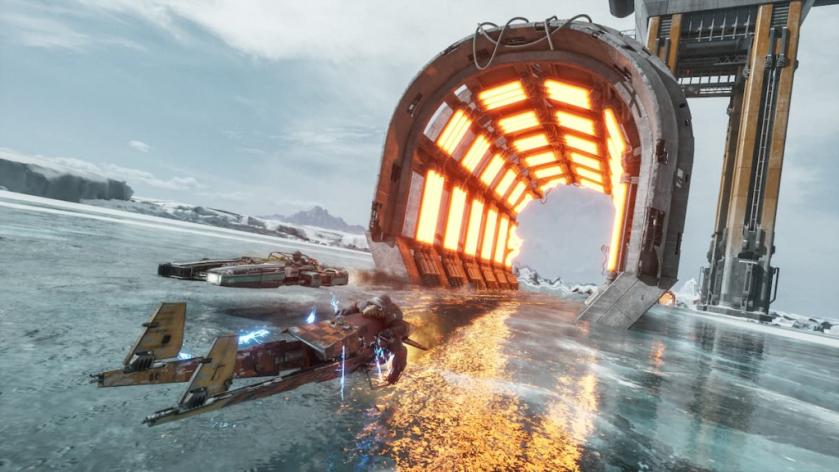
In truth, what everyone’s here for is the racing.
But Galactic Racer doesn’t do it the way other games do. No, it actually incorporates roguelite mechanics and round-based racing to really kick things up a notch. In the campaign and some other modes, you will start the game off blank, and then earn new upgrades for your vehicle between each run, depending on the type of “encounter” or race you decided to choose.
This leads to a tremendous amount of replayability, with randomized levels and encounters changing how each “tour” plays out. It also rewards you for trying again, as you do get to keep some permanent rewards and bring them back home to make your vehicle get a better start next time.
This also comes with the extra baggage where, if you happen to fail a run at some point, you have to go aaaall of the way back to the start of the tour and do it all over again. The game, in general, tends to follow a zero sum design philosophy where you win or lose everything. That’s also reflected in its encounter types, like limited time challenges where you can fail a run if you’re even a second late on the clock. There’s no tier one, two, and three medals, but I guess it’s par for the course with the roguelike mechanics.
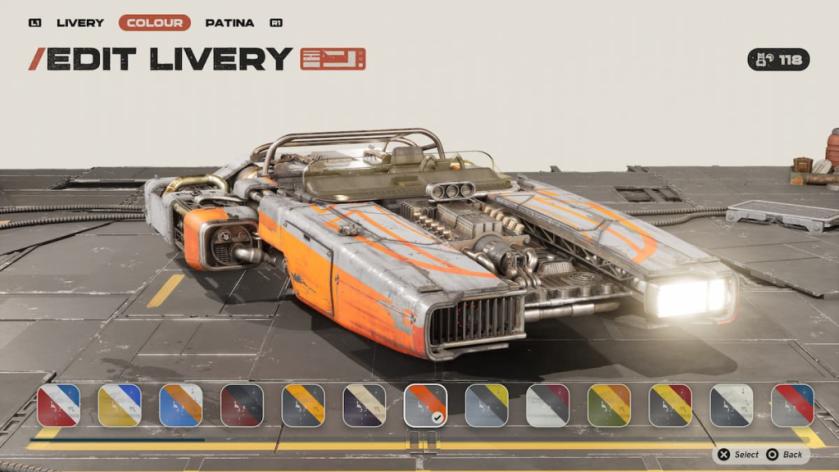
On the other hand, the racing itself is actually amazing, and Star Wars: Galactic Racer genuinely has the best vehicle handling I’ve ever come across in my two and a half decades on this planet. Every turn feels buttery smooth, the controls are responsive and tactile, everything you do gives you strong feedback to really let you know that you are, indeed, in control of this thing going at Mach 1 speeds.
Players can race in three distinct vehicle types: the Landspeeder, the Speeder Bike, and the Skim Speeder. Each of the vehicles races in different ways, with the Landspeeder being the all-rounder, the Bike focusing on superspeed, and the Skim Speeder being particularly effective in turning corners or drifting. I spent most of my time in the game in the Landspeeder and found it to be the most fun of the bunch.
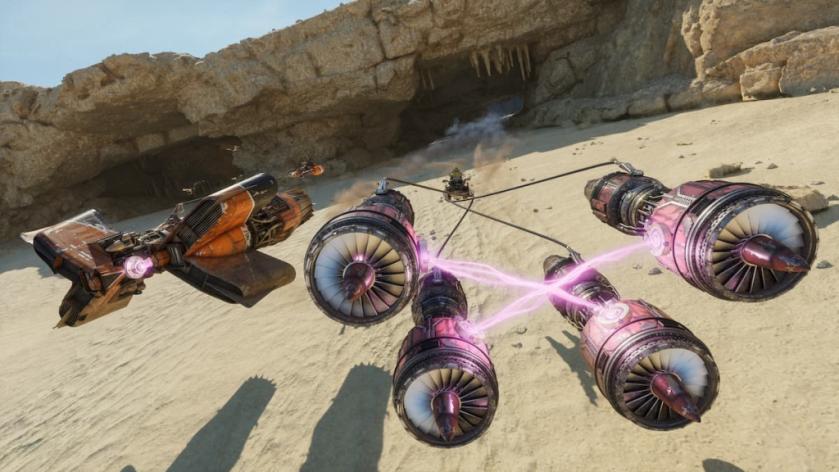
Now, most of you will probably wonder about the Pod Racers, and yes, they are in the game, but kept in separate modes and particular encounters and events in the campaign. They’re awesome to race in this game and despite their speed are actually very wieldy and easy to control. In fact, ease of control seems to have been a focal point for the developers, since each vehicle can be “broken in,” so to speak, without much frustration or hardship laid on the player.
Where the game really kicks things up is how its maps react to you. This is where it most staunchly diverges from the usual racing game trope and into Super Mario Kart territory. Vehicles have abilities, and the maps have environmental effects. Different effects can be used to sabotage you, or you can find ways to turn them to your advantage by building toward them, which meshes amazingly well with the roguelite side of the game.
For example, if a map has cold effects your engine will be a lot cooler, meaning you can use the Ramjet (supercharged turbo) for a lot longer. And vice-versa, if you’re burning you’re going to have your Ramjet botched unless you have builds to guard against that. Each map thus provides you with a starkly different experience, especially when your build comes into play, and the replay value goes up by a mile.
Now, as for the Mario Kart shenanigans, each vehicle can equip up to four abilities, which range from activating only when you crash to fixing damage on your vehicle or providing you with shields to straight up shooting rockets at other racers or laying down mines for them to get caught on. It’s really dynamic, and I can’t wait to see how players will find cool (and very annoying) ways to utilize these abilities in multiplayer.
A bit frustrating, but ultimately a good game
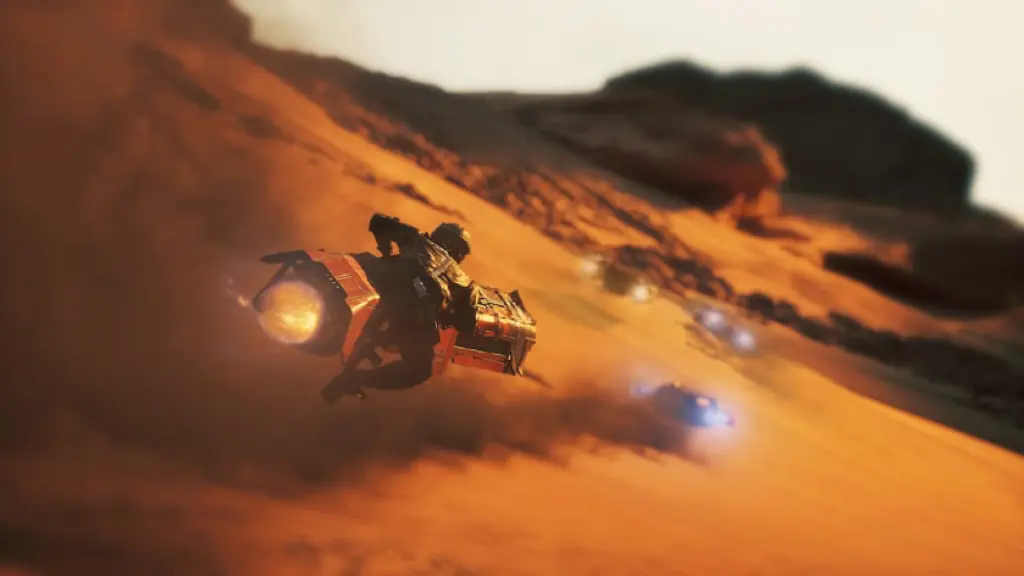
The roguelike design and the maps are, at times, quite a bit frustrating. The campaign can be artificially prolonged by a significant amount of time if you happen to constantly fail somewhere at the end, and since the game can throw curveballs at you with racers suddenly equipped with every ability under the sun, you can see why that wouldn’t be the most fun ride.
Some of the maps are borderline unfun and unfair to play. On one, there are huge pools of corrosive acid that, if you so much as touch it, can cancel out your entire Ramjet and deal significant damage to your vehicle, forcing on-the-run repairs and, well, crashes, that will more than likely set you back by a few spots.
Furthermore, Star Wars: Galactic Racer has a huge visibility problem. At such high speeds, it is somewhat expected to have a problem with visibility since everything is going so fast, but I cannot even begin to tell you how many times I had crashed or went off course because the entire environment blended together and had no clear demarcation of where exactly the racing path is supposed to go.
I’ve also kissed the walls head-on way too many times to count since turns would just suddenly appear.
At any rate, though, I had fun, and I’m definitely going to come back to this game once it goes live and has all the multiplayer servers live. I didn’t get to play the multiplayer with devs and journalists due to other stuff I had to do, but I hope to make up for that once the game is actually out.


