


When I got pinged to do a review on Ace Combat, I have to admit I hesitated for a while. I knew nothing about the franchise. I mean, I did hear of it, but I had never played any of the games before. But now, over 30 hours later, I am more than glad to have picked this one up, as I was genuinely surprised, if not shocked, by how good this series actually is.
Ace Combat 8 directly upgrades its predecessor, itself one of the most beloved games in the franchise, by refining its combat and gameplay while significantly boosting the narrative scope through exceptional characters, relationships, and a generally dark and brooding atmosphere that lends itself perfectly to the game’s overall philosophical considerations of war.
Here is our full review.
The Wings of Theve
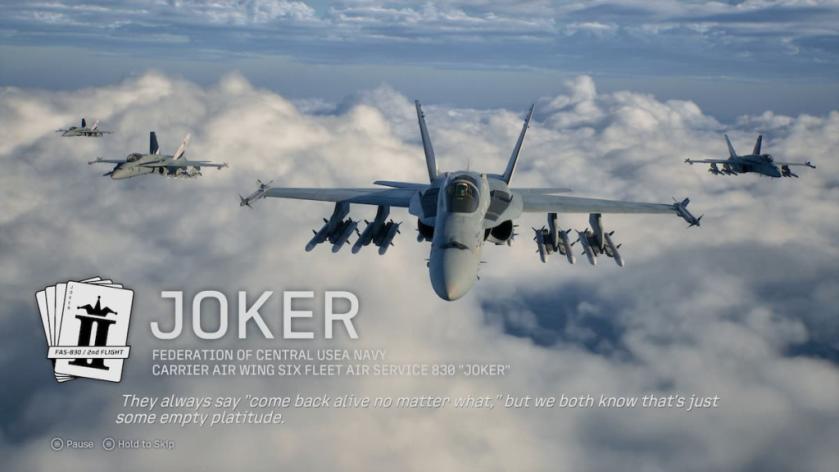
Ace Combat 8 is set in the series’ most recognizable world: Strangereal. It’s Earth, but very different from how we know it. You play as a silent protagonist, Rex, accompanied by the apparent spirit of his KIA’d comrade, Jan Cope, who, through his introspective and retrospective commentary, gives our anonymous character a face and a voice.
Rex takes over Cope’s callsign in the Wings of Theve, a near-mythical flight crew fighting to reestablish the Federation of Central Usea, a state wholly occupied by a foreign invading power, Sotoa. Sotoa attacks the FCU because its own land is becoming barren and useless amid rapid industrialization, and so its only hope is to snatch some arable and fertile soil from others.
You lead your crew of pilots on a journey from losing all political recognition and power to reestablishing the FCU and taking the fight back to the Sotoans.
This war forms the backbone of the game’s story, granting the game’s significant cast of characters a very strong context to exist in and develop their interpersonal relationships, which are conditioned not only by the characters themselves and their personalities but also by external factors that can, at any point in time, rip everything straight away from them.
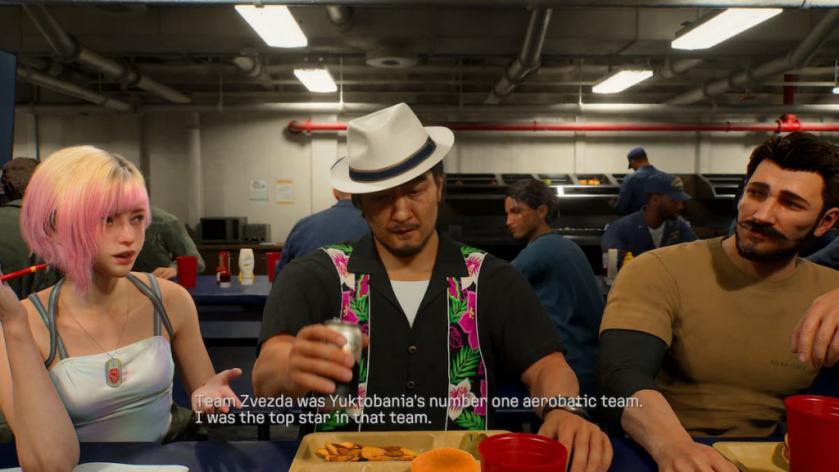
These relationships are the strongest part of the narrative as well, with each of the characters being super believable and realistic, if a bit embellished by the game’s overreliance on shonen-type storytelling and larger-than-life personas and characterization tropes. They start off as relative strangers but form tight bonds both up in the air and on the ground with the war and how they fight in it, bringing them ever closer together.
Most of the characters go through a great arc from start to finish, and while some get more growth than others, I’d have loved to spend more time with each cast member. They’re all just so iconic, especially those you saw most heavily marketed in the game, like Tasha or Baxter, and could easily have come out from other well-known ace pilot franchises like Top Gun.
Read what’s behind the latest news in gaming (with a bit of snark) by subscribing to the Destructoid Checkpoint newsletter!
The entire game overall embraces grandeur and epic scale, taking mundane elements from real life like pilot squadrons and turning them into archetypical villains with exceptional aesthetics and music attached to them. When the Shadows, the game’s chief antagonists, appear on the map, you instantly know that you’re not dealing with any ordinary pilots. And when their leaders are there, then boy, you’re dead certain that something is about to go down.
This extends to every single bit of the game’s story, which is, in every sense of the phrase, larger than life. It enriches what we know about militaries and conflicts, and it borrows liberally from such series as Armored Core and Front Mission and Metal Gear to deliver a ridiculous yet entirely comprehensive world.
And on top of that, it introduces, like I’ve said, the character of Jan Cope, who spends the entire game dwelling on the idea of war, a soldier’s position within it, the point of it all. He reminisces on his past which his spirit is now largely forgetting, speaks to Rex as a sort of successor but also as someone who’s surpassed him, and in some way communicates with the player himself on these powerful and striking subjects.
Somehow, Ace Combat 8 is at once completely bonkers and serious, simultaneously fiction and realistic. It’s a striking contrast, really, and it works quite well most of the time.
The only problem with Ace Combat 8‘s story is how that story is told. The game adopts a very weird way to present the events of the game by forcing the player into semi-cutscenes where you can move the camera around but neither speak nor move. You are sometimes given yes and no prompts, but choosing either does not seem to impact the gameplay much, and the cutscenes themselves sometimes just fade to black at the most random moments without offering a proper closure to a specific scene or dialogue or event.
It’s a minor problem, really, and one that generally goes away by the end of the game, which is when the best parts of the story actually happen.
Furthermore, the game’s clear inspiration by anime and shonen archetypes sometimes adversely impacts the overall atmosphere, which often tends to be quite grim and gritty and serious. For example, Tasha and the rest of Joker Flight (your crew) will be in the midst of some horrible battle where Rex, the player, is raking in dozens of literal kills, and she’d be laughing and joking about it while asking Coster to play a song for her on the radio.
There are also those anime grunts and sighs and all that happening constantly, and while they’re not necessarily a problem, they do have a knack to bring things down a notch when they really shouldn’t be doing so.
Ace COMBAT
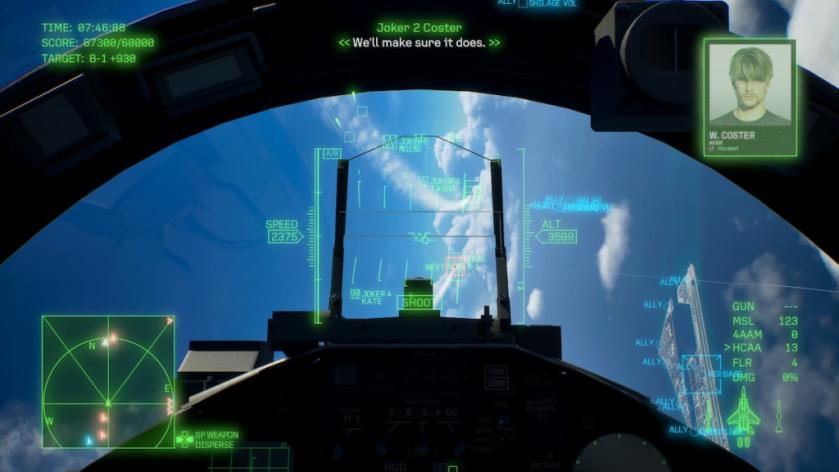
Of course, it wouldn’t be an Ace Combat review if we didn’t talk about… well, the combat. The game largely features the same overall combat and gameplay structure as other Ace Combat titles, meaning you get to control a semi-arcade plane in one of three perspectives, equipped with main missiles (they are capped off in this game) and special weapons.
To get more planes, special weapons, and upgrades, you need to spend points to unlock them, and you earn points based on how well you did in a mission and what grade you got.
There are several dozen planes in the game, most of which also exist in real life, such as F-22 Raptors, F-15s, F-16s, MiGs, Sukhois, Mirage 2000, Eurofighters, Rafales, and so on. There are several fictional planes, too, mostly used by the game’s bosses and most notorious pilots as a way to elevate their status as being above and beyond any conventional warfare.
Each plane can be equipped with up to two special weapons, and depending on the type of plane you have, you can either use rockets, bombs, or support tools. Some missions may require more air-to-ground warfare, and some may need you to stack up a bunch of air-to-air weapons, which is how the game keeps the gameplay fresh between missions and staves off repetitiveness.
Speaking of which, I played through the entire game and never—not even once—did I feel it was getting repetitive or stale. The way you destroy targets is incredibly satisfying, and chasing points only adds to that. Dogfights are intense, brutal, and unrelenting, but the game’s uneven difficulty between assignments can be a bit jarring at times.
The missions are structured in various ways, usually unfolding as a narrative setting where you and your crew have a very specific assignment to do. Things tend to go south more often than not, meaning that missions tend to meander several types between at once. In general, you either destroy enemy targets until they are all eliminated, do annihilation battles to rack up enough points within a specific time frame, or take on boss fights, or a combination of the three.
I played on the realistic flight controls, which means I’d have to roll the plane into a vertical position to be able to take turns, but the game features an arcade control scheme allowing you to turn simply by holding left or right.
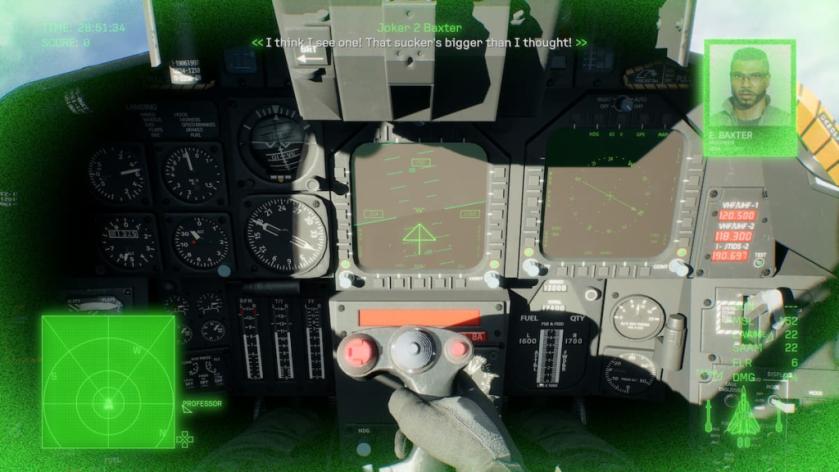
With the realistic controls, every dogfight was a test of skill, though getting lost in the air happened to me more times than I’d like to admit, not least because I also played from the cockpit perspective. The realism of the game’s graphics and the attention to detail within the cockpit itself, as well as how the perspective impacts the game’s overall presentation, simply drew me to this choice of perspective, and after over 30 hours I wouldn’t have it otherwise.
The game’s multiplayer is quite fun, too, but I wouldn’t consider it to be a core component. I mostly liked team deathmatch and free-for-alls, as those mimicked some of the strongest moments from the story, while the rest of the modes felt like just extra baggage and a justification for the already-planned seasonal battle pass.
Overall, Ace Combat 8 is not a simulation game by any means, but it goes to great lengths to ensure the sense of realism is intact for its dogfights and combat, especially when it comes to the little, almost unnoticable details that Bandai paid special care to include.
The most beautiful game of this year
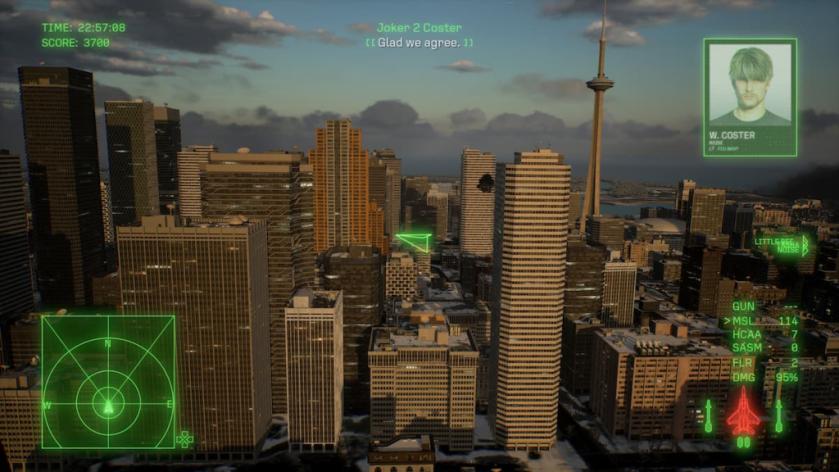
I’ve got to admit, I use the phrase “the best/most of” way too often in these reviews and articles, but in this case it’s genuinely a must. Ace Combat 8 is one of the best-looking games I’ve ever laid my eyes on, and that extends to both its graphical fidelity and animations and overall art direction.
The main characters in the story all look as lifelike as they can possibly get, while the rest of the game often features moments where it’s honestly impossible to tell whether it’s real life or not. It even goes to extreme lengths to ensure every part of the world is as rich in detail as possible, meaning even cities like Theve, which you will never really see from up close on the ground, are exceptionally pretty and high-fidelity. No part of the game is spared the attention, and that’s a big part of why Ace Combat 8 is so great.
The lighting, too, is off the charts, as are the clouds, the water, explosion effects, particles, and so on and so forth.
And what’s more, the game does all of this—in Unreal Engine 5, mind you—while running buttery smoothly on my 9070 XT and 5800X3D at native resolution with all the settings maxed out. It never lagged or dropped FPS below 60, except in some cutscenes, though I don’t know how much of that was intentional. Even during the most intense and visually stunning combat scenes, the game stayed consistently above 60 and was a smooth ride from start to finish.
An impressive comeback for the series
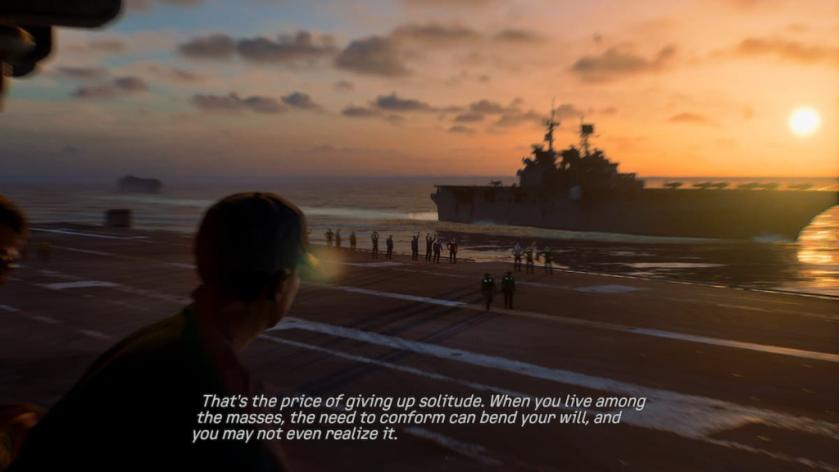
Ace Combat 7 was a beloved game and remains one of the best in the series. However, by significantly expanding the story and introducing so many likeable characters, Wings of Theve can simply be viewed as a direct upgrade over its predecessor. The combat is largely the same, though refined and made more visually appealing, but it’s the story and the depth of its themes and characters that really stick out.


