

Dicey
The moment I saw Dynetzzle Extended, I wanted it. Dice logic, spatial reasoning, atmospheric music, and a clean aesthetic. It was my jam.
Two hours later, I became a little chilly on it. Where I went in hoping for a nice session of deep thought, I came out the other side with something that feels more like sudoku. It’s built on a cool idea, but soon enough it becomes rote.

Dynetzzle Extended (PC)
Developer: Vishnu Vadakke Pariyarath
Publisher: Vishnu Vadakke Pariyarath
Released: March 15, 2016
MSRP: $0.99
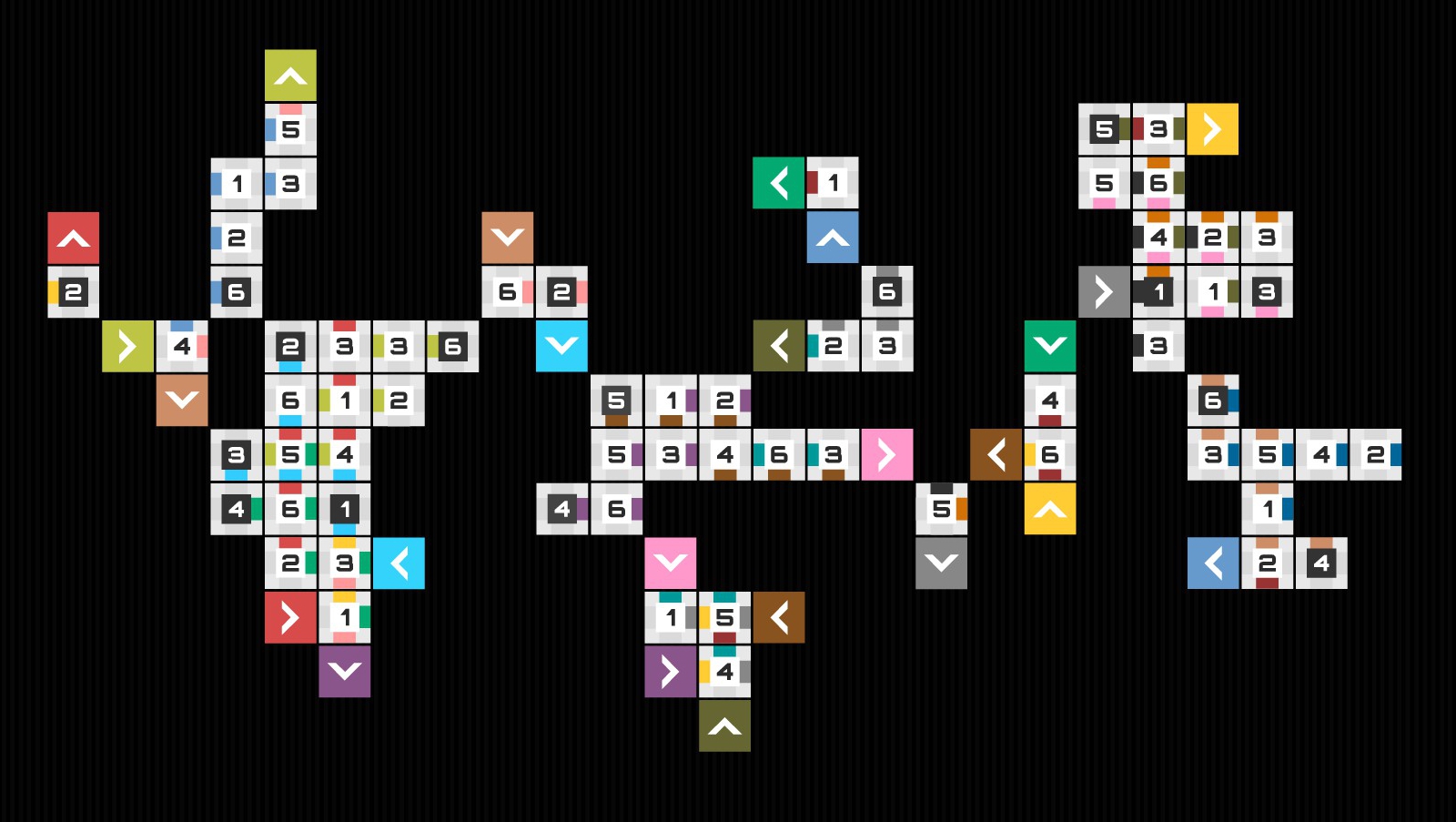
Cubes are three-dimensional objects, but they can be represented in two dimensions by nets. Standard six-sided dice are designed such that opposite sides always add up to seven. With those two pieces of information, all of Dynetzzle‘s puzzles can be solved. It provides a partially-filled arrangement of nets and tasks players with entering the missing numbers to complete the grid.
It recommends imagining how each net would fold into a cube and assigning numbers according to this mental picture. At first, that’s the route I took, and it was a cute brain exercise. Soon enough a simpler algorithm becomes apparent, one that bypasses the spatial reasoning part and leaves everything in two dimensions.
At this point, Dynetzzle becomes much less satisfying. It still takes some thought, but it feels more like shifting into autopilot, zoning out, and letting a set of simple if-then statements play out.
This keeps up for the first 20 of the 25 stages. For the last five, Dynetzzle introduces a new mechanic that throws a wrench in the works, requiring mental rotation of the two-dimensional nets in order to proceed. These stages bring back the feeling from the beginning, where it takes a more active thought process to proceed.
This is when Dynetzzle is as its best, but alas, it’s over just as soon as it starts to pick up. If it had infinite procedural generation for its puzzles, I could see it being a sort of daily routine type of game, like how grandma does crosswords in the newspaper or the Destructoid team used to do the Jumble.
Its aesthetics help toward that end. The graphic design is clean and easy to read (though the reliance on differentiating between similar colors would make it unplayable for the colorblind), and the atmospheric music creates a soothing atmosphere.

Ultimately, Dynetzzle Extended is a decent experience. It starts with a cool idea, but doesn’t expand on that idea enough, and once it finally reaches a point where it takes more than just mindlessly following the algorithm, it ends. It’s a neat distraction for puzzle enthusiasts, but it won’t be setting the world on fire.
[This review is based on a retail build of the game provided by the publisher.]


