


Back in 2009 or 2010, I played my last LEGO game, which was the first Indiana Jones. I was absolutely obsessed with it as a kid and played through each of its sections countless times, to the degree that my sorry PC at the time could handle.
And so going into Legacy of the Dark Knight, I had a lot of nostalgia just waiting to activate, but what I got was both a good nostalgia trip and a damn good, modern gaming experience on top.
LEGO Batman: Legacy of the Dark Knight is hands down one of the best Batman experiences since the Arkham series, and since it takes liberal inspiration from it (and every other Batman sub-franchise), it’s truly a worthy successor to Rocksteady’s trilogy, even if it is a lot less serious and gritty.
So, here is our full review.
A trip down memory lane

LEGO Batman: Legacy of the Dark Knight puts you primarily in the shoes of Bruce Wayne, starting you off with his childhood and the infamous murder of his parents, and then taking you through different iconic periods, from the Joker’s first appearance as Red Hood One to fighting Mr. Freeze and stopping his new Ice Age.
The game is structured as chapters in a series of relatively related events, where you fight a new big supervillain and go through the origin stories of new characters each time as they slowly but surely start to meld into a new Bat-family.
The story is witty and cleverly written, a little serious when it has to be but comedic most of the time, with some actually incredible jokes in there and a lot—and I mean a lot—of references to things outside of Batman and, of course, other Batman movies, games, and TV shows.
As you unlock characters, you get the ability to switch between them, and you’ll be doing a lot of that, too, since the game appears to have been built with co-op in mind, or at least with the idea that little old Bruce can’t do all the heavy lifting on his own. In fact, I’d say given the emphasis on character swaps, that co-op was the main idea behind this game, though it’s still more than playable as a solo adventure.
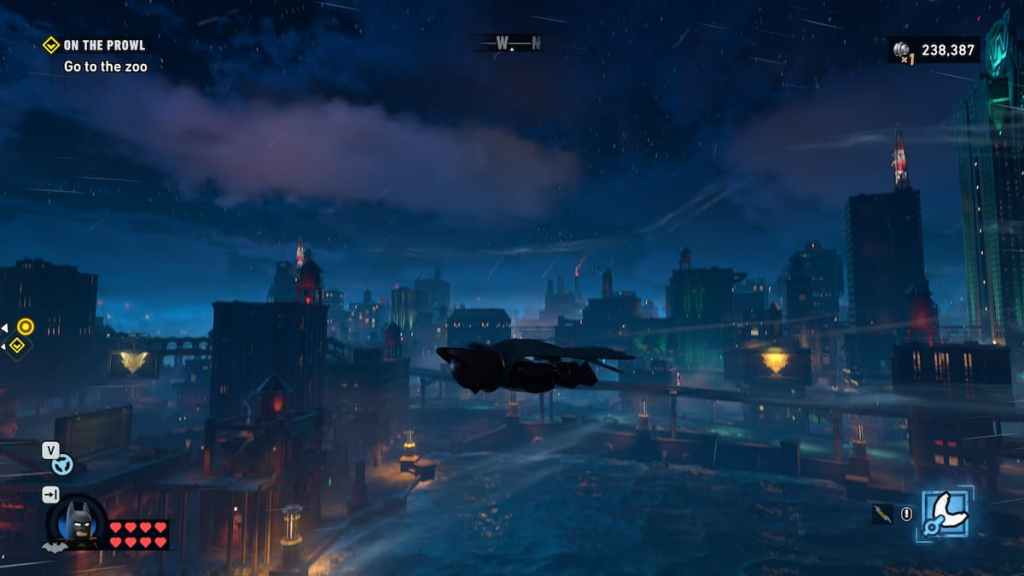
The stories within chapters unfold as missions, some of which take place in the broader world of Gotham (which, by the way, is absolutely gorgeous and fun to just walk, glide, or drive through), but most are set within structured, often interior areas with their own dedicated set of secrets and unlockables that you can collect to increase your completion level.
Overall, the story starts off serious, and in the first chapter, you have a feeling that Bruce is going on a revenge spree to find his parents’ killers, but that initial hook never pays off since the narrative goes in a completely different direction after the first chapter. Still, it wanted to incorporate as much of Batman as a character with so many different iterations and versions that I don’t see that as an issue.
This game is a catch-all Batman experience where your knowledge of the character and his various appearances will pay off, and it feels genuinely rewarding to spot and understand each of the references, especially when some parts of the story are more or less one-to-one reenactments of popular Batman moments in other media.
You also are exposed to the actual comics in a way, since most of the smaller stories in these chapters are taken straight from them.
But for the most part, you have so much to do in Gotham proper that following the story to a tee isn’t your main goal.
From unlocking all the fast-travel points to solving Riddler puzzles to searching for secrets and various rewards, you’ll spend most of your time riding in one of over a dozen Batmobiles or gliding over the cityscape using a grappling hook to launch yourself in the air. You’re going to find yourself spending such a damn good chunk of time outside of missions that it really doesn’t matter how great they are.
The missions are also rather easy, and the worst part about them is just how much Batman and the other characters love to comment and tell you exactly what you need to do.
Obviously, you sometimes have to build something, but the characters never miss an opportunity to say, “Perhaps I should build something to get me through that door,” or, “That vent seems like the only way out,” or, “I think that crack in the window is the best way forward,” or other things along those lines.
That gets super annoying rather quickly, but there are many moments in secret hunting where those hints completely stop; they’re tied to the main story and nothing else. I also found some of the Gotham secrets and puzzles to be repetitive, but most of them were interesting enough to engage and urge me to go out and explore.
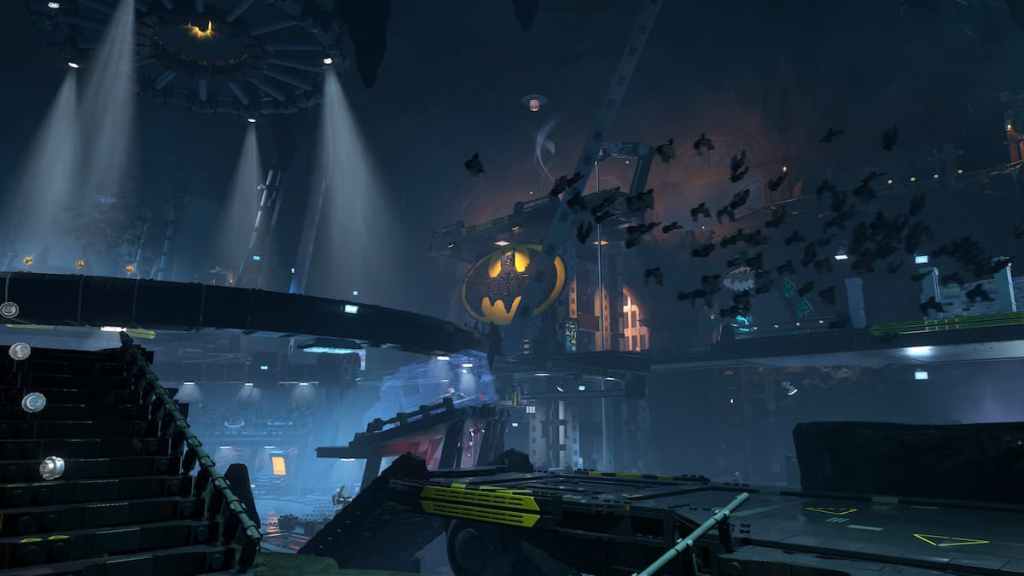
Fighting crime in the streets and doing all the other side stuff also comes with a lot of rewards redeemable at the Batcave, and seeing that place grow into a sprawling underground base that is almost fully customizable, with unique rewards from your crimefighting efforts, is a truly wonderful experience.
Somehow, Arkham returned

Gotham is massive and stunningly beautiful and is certainly one of the best open worlds that I’ve experienced in the last few years. Everything about this game, from its combat to the world design, screams Arkham trilogy, though, and its city could just as easily be confused for an Arkham Knight setting rather than a LEGO one.
It’s dark and mixed with neon violet and cyan lights that give it this ethereal, almost vampiric look that certainly maintains the overall Gothic character of the city, which is also combined with some modern architecture that doesn’t take away from the dominant Art Deco aesthetic.
Just driving around in your Batmobile feels like you’re playing Arkham City or Arkham Knight, and when you get into combat, that feeling comes full circle, and you feel like you genuinely never left Rocksteady’s games. The combat essentially revolves around you mashing the attack button with Batman or your other character flying between enemies, punching them with comic book effects splashing around.
You can counter whenever an enemy intends to attack you, but you also have dodges for some more deadly strikes.
A focus bar that fills up through combat lets you take enemies down immediately or do a good chunk of damage to larger foes. Overall, it’s a carbon copy of what was in the Arkham games, but also feels very, very familiar to the recent Spider-Man games.
And while simplistic, I actually found fighting larger groups of enemies a lot more fun than expected from such an automated system. If you time your punches and click the attack button at exactly the right moments, you get double damage, and getting into that rhythm was an immensely satisfying experience to which the audio and visual effects lend themselves perfectly.
Furthermore, there are parts of the game that completely reenact Arkham Asylum from the ground up, of course, with comedy, irony, and fourth-wall breaks galore. But, as I’ve said, this game can be considered a successor to Rocksteady’s golden age (we don’t speak of Kill the Justice League) as it plays and feels exactly like an Arkham game, but is transported into a new, less grimy context.
A nice ride through and through
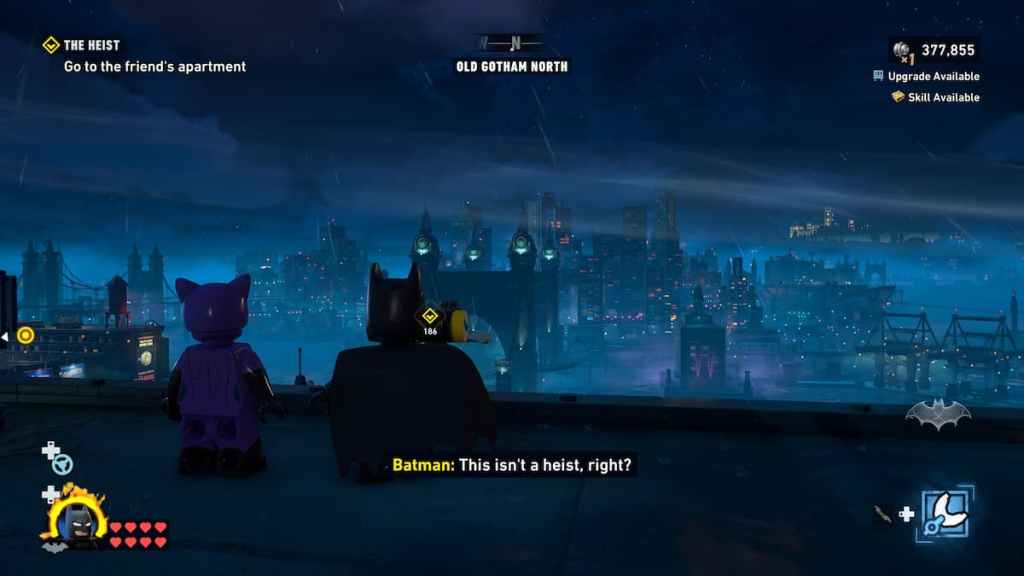
Overall, LEGO Batman: Legacy of the Dark Knight takes the best inspirations and combines them into an incredibly fun experience for every age.
It’s very easy and at times repetitive, with forced character swaps sometimes feeling out of place or annoying when playing alone. Thankfully, each of them is unique and different enough with their own set of gadgets that they tend to grow on you.
The story isn’t amazing, and its coherence is at times lacking, but it all comes together by the end and feels quite satisfying.
Gotham is genuinely incredible and pairs perfectly with simple but effective combat that doesn’t make every night patrol around town into a chore, while the broader open world offers a good amount of side content, puzzles, and unlockables, so it’s never boring to take your sidekick into the back alleys of the most crime-ridden town in America.
It also might not be the game for everyone and is almost certainly geared towards a younger audience, but it’s nevertheless a good entry point for new generations to familiarize themselves with the Caped Crusader before moving on to more serious media.
And as an aside, I played the game on a 9070 XT and 5800X3D with 32GB of DDR4 RAM at the High preset and a native 4K resolution, and I have to say the visuals on this game, even on High, are so gorgeous that I couldn’t believe how well it ran at native 4K. It actually surprised me to see lighting that good in a LEGO game of all things.
I know the devs put out some daunting system requirements, but that could have been a lowball since it’s very well optimized with no bugs, stutters, or crashes to speak of.


