


The Cassiopeia, carrying 10 brave astronauts, entered space 12 light-years ago in search of a new planet. The Earth is dying, and the fate of humanity rests in your hands. Yet, questions of our own humanity arise when alien life threatens our very existence. What do you do when orders tell you to follow Directive 8020?
Coming in at $49.99 and taking me roughly 12 hours to get the best ending possible, Directive 8020 brings replayability to the forefront while letting its gameplay falter at the hands of predictability. A fan of Supermassive Games and Dark Pictures, I went into Directive 8020 hoping for something brilliant, following an underwhelming Casting of Frank Stone, only to be left with similar feelings of disappointment.
A strong start

Directive 8020 takes the reins of this sci-fi adventure by guiding us into immediate conflict, where we get to know two members of our Cassiopeia crew. We’re immediately shown chemistry between the pair, Carter and Simms (the former a playable character), where the inciting incident shows a meteor causing structural damage on the ship. While the opening can feel somewhat calm with the pretty visuals of space surrounding the pair, it’s also atmospheric as the stakes are high off-rip and isolation is at its peak in this title.
Its strong start, full of mystery and intrigue, gets thrown off course when we take a leap — both physically and temporally. A shift in perspective and now jumping into the near future, Directive 8020 slowly lets go of its reins as that pull it had on me slips from its fingers chapter by chapter. This sci-fi title started strong, but suffered from what many storytellers dread—a saggy middle. It didn’t take long before I grew tired, and my disappointment festered longer than any scare could last.
Directive 8020 goes where no Dark Picture has before: Stealth

While exploration came with ease and carried some of the atmospheric tension to start, the unfathomable amount of stealth in this title made it, frankly, exhausting to play through. I initially welcomed this change with open arms, excited to see something different, blending the interactive horror film experience with what we typically expect from survival horror. But the anticipation was shot down faster than the Cassiopeia, for whenever a threat showed itself on-screen, objective ‘sneak past the enemy’ ensued. It was a sure-fire way to kill all tension and dread, for not only did I know what was coming (and couldn’t believe my eyes every time), but I knew exactly how to handle it.
Instead of feeling pressed for time by a challenging quick-time event (QTE), or one of those iconic (albeit at times frustrating) mechanics from previous Dark Pictures and Supermassive Games’ titles such as Don’t Move, Don’t Breathe, or Keep Calm; I had all the time in the world to get past the basic enemy AI performing the most predictable patrol and being followed around as I completed objectives. There was no pressure. What added to the frustration of these tedious sections that made 8020‘s gameplay loop the laziest in the Anthology so far was how Supermassive had ample opportunities to switch up the gameplay, but never did. Cutscenes would show the character holding their breath, hiding behind cover as the enemy closed in, only to return control to the player for a bit of stealth “action.” It not only slowed the pace of the game but also downgraded the overall quality of this experience, for nothing is less terrifying than a combination of seeing the monster and having to complete the same action over and over again.

The saggy middle of Directive 8020 didn’t only come in its poor choice of gameplay mechanics. The limited amount of QTEs (that lacked any real challenge whenever they showed), paired with the jumbled narrative choice to timejump from episodes two through five, gave me a whiplash of emotions. Every time I’d feel myself being pulled into the story and its characters, it’d leave me stranded. Scenes wouldn’t last longer than a few minutes before jumping to another timeline, showing a different character handling an issue we wouldn’t see wrapped up until a later episode. The storytelling became stale, predictable, and repetitive, where a clunky narrative juggles maintaining your attention with not spoiling the leading mystery. It created an atmosphere that suffocated itself, for no negative emotion tied to a good scare could fester long enough to count. This made Directive 8020 woefully unscary, topped by the jarring score choice at the end of each episode that made me feel like what I’d just played through wasn’t to be taken seriously.
Moments of greatness

Though the characters continously make eye-rolling scripted decisions, they are significantly stronger and more memorable than most Dark Pictures casts, and carry the clunky storytelling when the narrative jumps from one moment to another. Lore and exposition are delivered through the cleverly implemented messaging feature that isn’t forced upon you. It lets characters develop off-screen and provide more backstory, a welcome addition, adding a layer of believability to a cast that otherwise acts far too nonchalantly about what is unfolding on-screen. But because it’s optional, you risk narrative gaps if you ignore it. Ideas mentioned in passing will lose context or weight, since you’ve missed the messages. This, plus how character arcs are pretty much non-existent, turns this adventure into one about survival. There is little payoff with the cast because nothing really forces them to change.
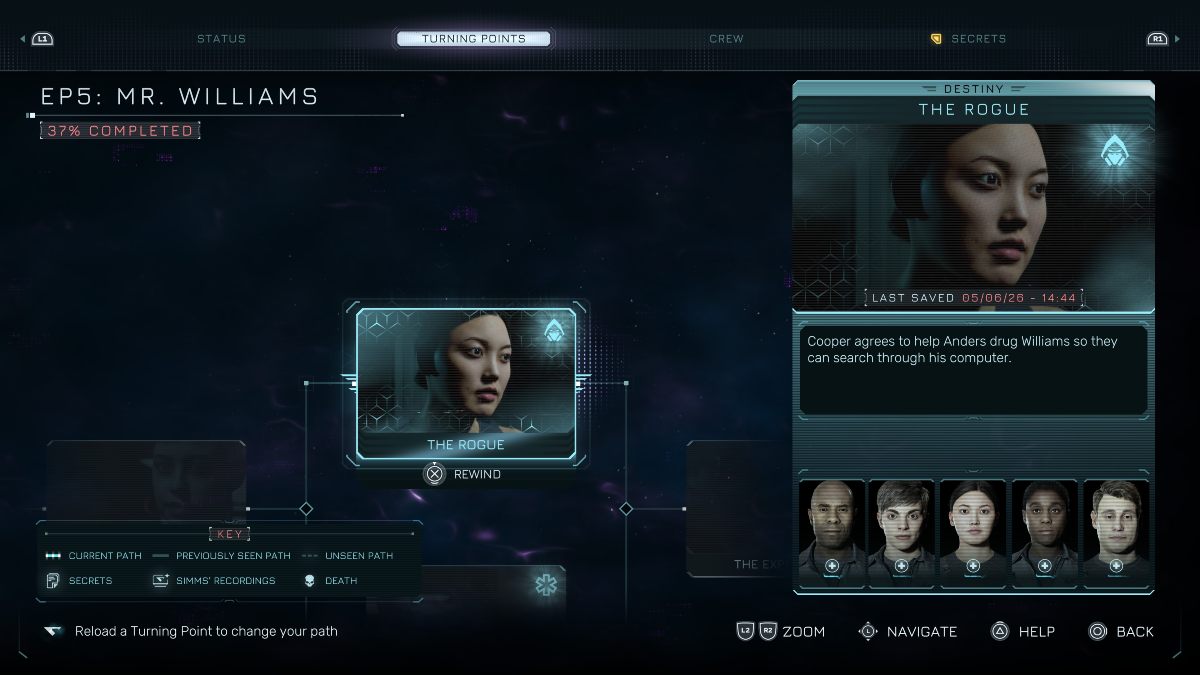
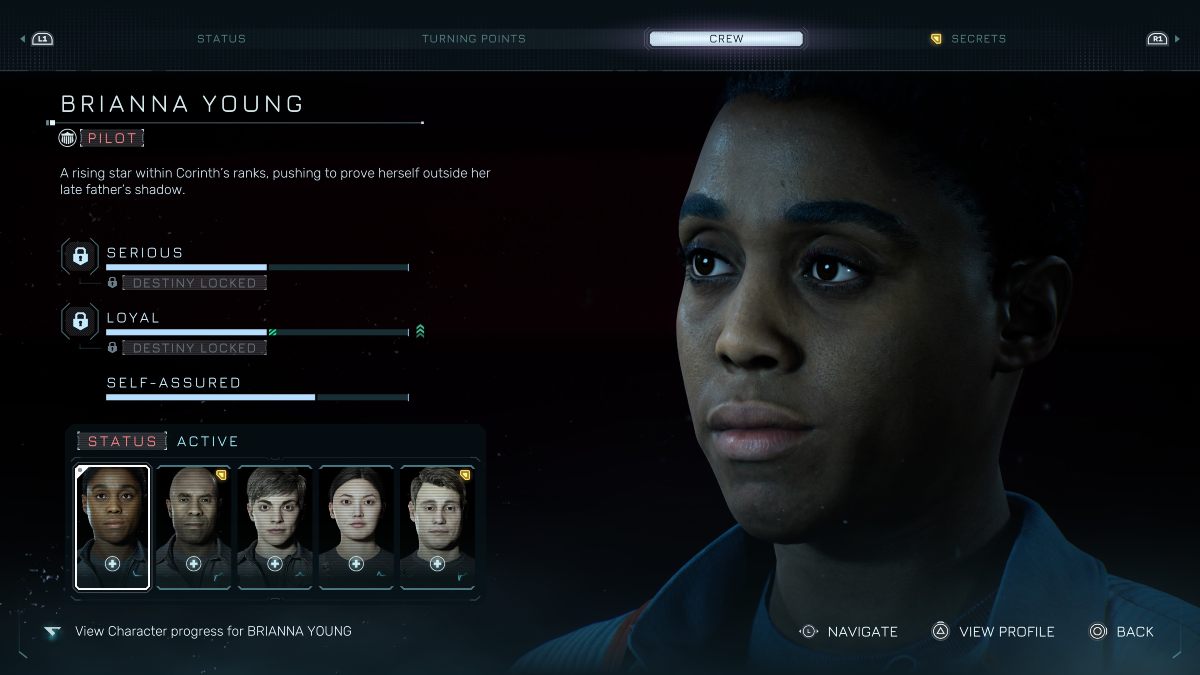
Directive 8020 introduces Destinies into this Dark Pictures as a means to mold your character, where choices directly impact who they turn out to be, thus affecting their choices in the long run. It is a mechanic not too dissimilar to Little Hope, but is implemented from the start, making it an entertaining addition that actually has consequences if you don’t pay close enough attention to the kind of person you’re playing as. Destinies anchor you to the character, and no longer feel as stereotypical as they did in Until Dawn. They’re not just character traits or tropes, but an explanation for their attitude, values, and behavior.
Engineering lore

Like in any interactive horror, roaming around freely lets you snoop the environment for lore and juicy secrets. 8020 has an array of them (60 to be exact), providing not only a history of this atmospheric universe, but adding variety to the gameplay by throwing in puzzle-solving, notes, and recordings. Cassiopeia’s history is embedded into the collectibles, which makes it a crucial part of the story, but it’s done naturally and tastefully so that it never inflates the overarching plot with filler and exposition.
In a similar vein, the scanner is a core component of the gameplay but isn’t enforced until required in the narrative. The scanner and objective marker help guide you through 8020. The more you rely on it, the greater the horror dwindles. It continuously updates to tell you where to go, ensuring you never lose sight of your objective. The scanner outlines where an enemy is and has a small cooldown before you can use it again. It’s useful enough that the stealth sections are too easy, but like most mechanics in this game, you don’t have to use it. The AI’s lack of spatial awareness and, at times, complete inability to see you means you shouldn’t need to rely on the scanner unless the situation calls for it.
Paranoia

There is a turning point in 8020 that regains the control it had at the start and lays the horror on thick. As soon as we switch back to linear storytelling, Directive 8020 becomes damn good. It is atmospheric, gripping, and manages to build tension without tapering off. Sure, the stealth doesn’t go anywhere, but by this point, I’m unfazed by it. While it wasn’t ever difficult to keep people alive, the events from episode six onwards are pure sci-fi chaos reminiscent of Coherence, Alien, Capricorn One, and The Thing, where paranoia has spread amongst the crew and hopes to infect you, too. If only this was the standard for all eight episodes.
Metamorphosis into fully realized butterfly effect

Rather than having a silly amount of endings that’d take too long to get, 8020 is designed like a film with a director’s cut. There may not be hundreds of endings, but there are substantial differences between them. Playing through this game, regardless of the repetitive gameplay that initially felt like trudging along, no longer feels like a slog to beat. It gets easier every time and feels worth it just to see the total package. Here is where Turning Points come in.
What was previously the Cutting Room Floor in Frank Stone is now the Turning Points menu that lets you jump to any choice you’ve made in an episode. You don’t even have to finish the game to use it, either. In Explorer mode, Turning Points are infinite, letting you jump back and forth between two timelines. Got a Destiny you don’t want? Alter your character’s dialogue from earlier. A character died when you’re trying to save them all? Rewind to the last choice. It’s polished, effective, and welcoming after a subpar Devil in Me. 8020 is extremely streamlined and has the best replayability of any Dark Pictures title. It’s so close to perfection. If Supermassive were to keep anything from 8020, it has to be the Turning Points.

I really wanted to love this game, and there are elements I thoroughly adored. It could have been up there with the greats, sitting alongside House of Ashes for best Dark Picture. Sadly, Directive 8020 fails from a narrative and gameplay standpoint, and while it does redeem itself from that saggy middle, it doesn’t do enough for me to ignore its glaring flaws. If you don’t mind the repetitive gameplay that flatlines any momentum and tension, then Directive 8020 may hit like Until Dawn did back in 2015. I strongly believe Directive 8020 should have spent more time developing in cryosleep.
It had huge potential, and I’m still looking forward to the future of Dark Pictures, but for now, I’ll be mourning what could have been with Directive 8020.


