


At Gamescom, I got to play Total War: Warhammer 40,000 early. I covered my impressions in our newsletter’s special edition, which you should totally subscribe to, but now I wanna talk about all of what I saw (and heard) during the whole ordeal.
The most interesting part, of course, is what Creative Assembly plans to do with this franchise. At the moment, all that the devs could reveal to me is that TW: Warhammer 40K comes out sometime in 2027.
When that will happen exactly is still under wraps, but from what I saw with the game and its level of completion, I wouldn’t be surprised if it was ~June 2027 at the earliest, if not fall release season next year.
Furthermore, I was told that CA is aiming for “10 or so years” of Total War: Warhammer 40,000. What that means exactly is, again, a bit of a mystery, but it could very well be a similar structure to what it followed while developing the Warhammer Fantasy trilogy. Those games were released within six years, around three years between each, and the last one’s been supported for the last four.
With the End Times now being added into Total War: Warhammer 3, I’d say that the 10-year support cycle is slowly coming to a close for the trilogy, with CA then pivoting to give its all to supporting Warhammer 40K. We could thus see a second game sometime in 2030, then a third game in 2023, and then four or five years of continuous support to that last title, which means I’d be near 40 by the time CA ends its development of this new series.
Now, as for the game itself, I think it’s actually the best Total War I’ve played since Shogun 2. We got to control the Space Marines across three game modes: a tailored tutorial to teach us the long and short of the mechanics, a few turns of the campaign, and a challenge battle which I was apprently the fourth player out of hundreds to beat.
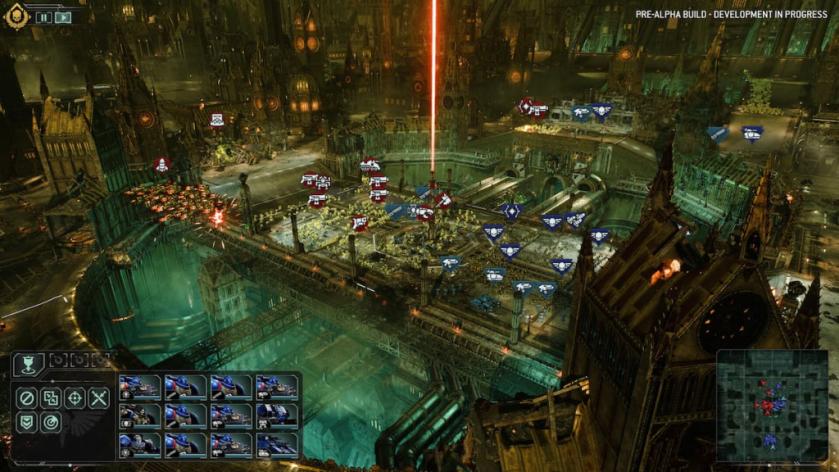
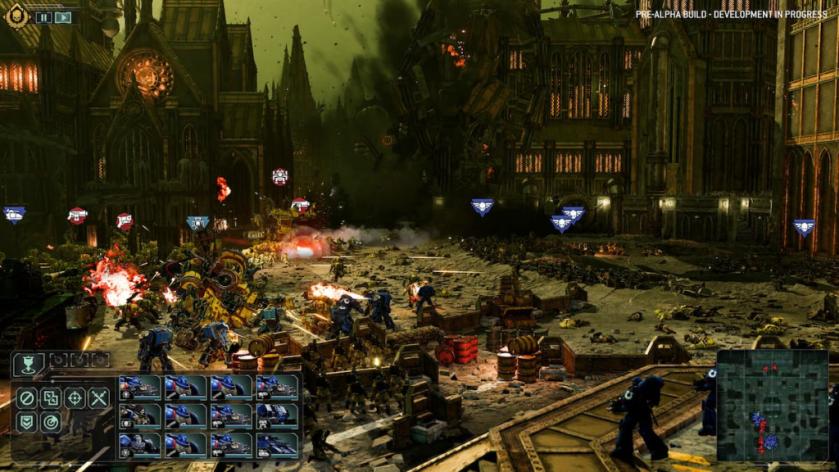
The battles, at least for the Space Marines, are a combination of taking cover and using your units’ bulky HP and power to whittle the enemies down and take on super large crowds at once. When things get shaky, the orbital support of Imperial ships comes in handy, with lasers and cluster strikes ravaging huge waves of greenskins.
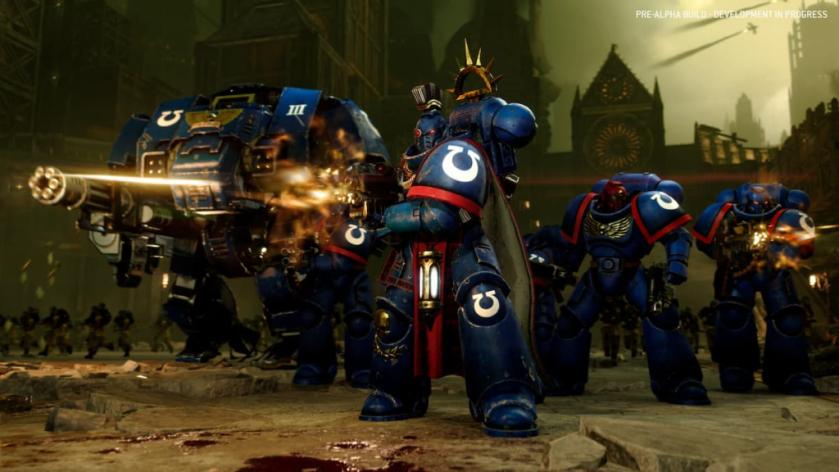
The Space Marines have a wide variety of units fit for every situation, and as the campaign showed us, you can finally recruit them without having to have them attached to a lord or general. Speaking of generals, they’re back to being full-blown units rather than single persons, with their own entourage of specially powered soldiers.
I didn’t get to see proper heroes or legendary units, but the Space Marines don’t really need those, being literal angels and all that.
Dreadnaughts and Leman Russes were also in the battles and the campaign, serving as mobile frontline units that can take a heavy beating from melee Orks but are also susceptible to anti-vehicle missiles that CA equipped the ravaging greenskins with.
The campaign map is separated into sectors, each of which has a garrison, but not all of the sectors can be attacked traditionally (at least not in this build). Only major settlements were interactable, but I did see the Space Marine faction having an outpost of sorts in one of its sectors, meaning you could probably build and expand to sectors eventually.
Each planet has a bunch of major settlements and sectors you need to deal with, and each system has a bunch of planets, and then we’ll probably have segmentums that themselves are full of different systems (didn’t see these, unfortunately), meaning this game is happening on a scale never seen before in Total War.
It’s also the first 18+ Total War game, and trust me, that’s for a good reason. The new engine was tailor-made for the Warhammer 40K setting, and every single bodypart can be torn off every single individual unit and has fully simulated physics, meaning heads and arms and legs can be bouncing off buildings and walls and land anywhere on the map.
I had so much fun with it that 45 minutes just wasn’t enough, especially since the Space Marines were so customizable (I made my own Blood Ravnes) and overpowered with the drop pods and orbital supports.
I cannot wait to see more, but that won’t happen before 2027.


