

Memories are all we have
The Annapurna Interactive Showcase from last week might have only been 25 minutes, but it was packed with all kinds of new trailers and info on upcoming releases. One game I hadn’t seen before was Hindsight, and as a lover of narrative games (especially those published by Annapurna), I knew it was one I wanted to try out.
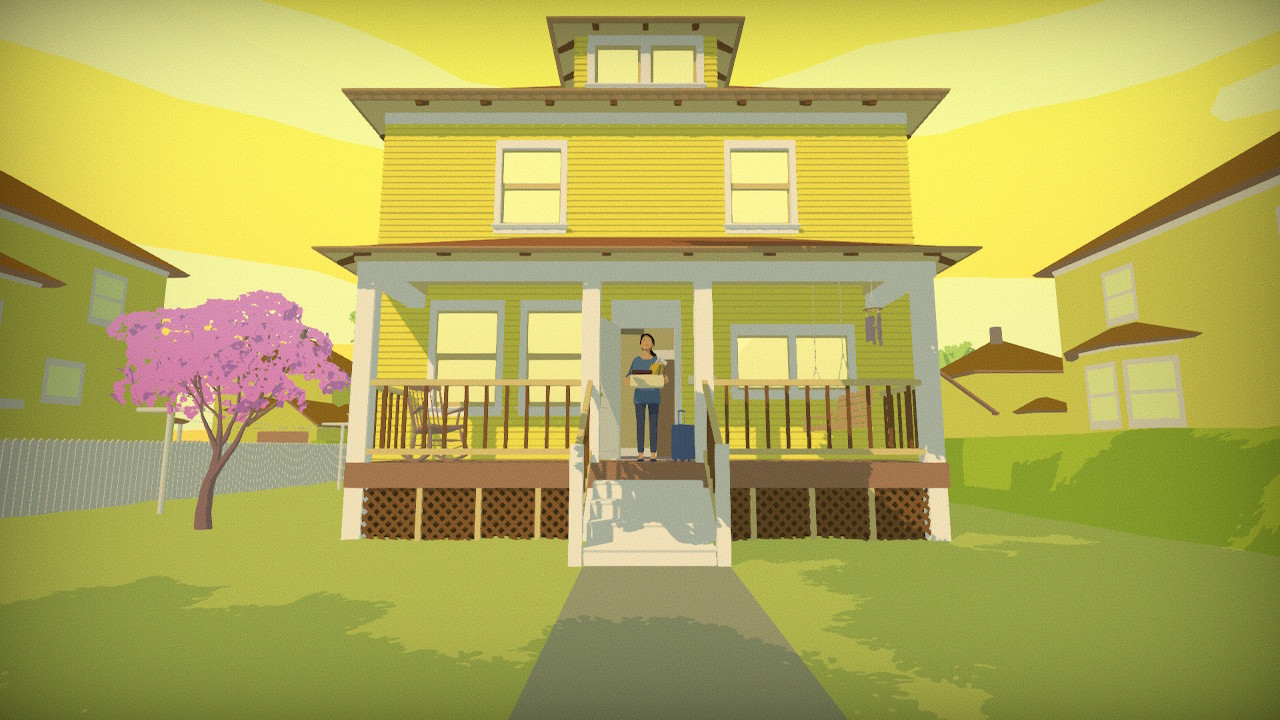
In Hindsight, you play as a woman named Mary, traveling through her memories as she recounts her relationship with her parents, her mother in particular. The two have a somewhat strained relationship, wherein Mary’s mother is controlling, which is often at odds with Mary acting like a normal kid.

Hindsight (PC, Nintendo Switch [Reviewed])
Developer: Team Hindsight
Publisher: Annapurna Interactive
Released: August 4, 2022
MSRP: $14.99
Here’s my problem — when looking at the big picture, the story of Hindsight is perfectly functional. It gives us hints here and there about the true nature of Mary’s relationship with her mother, of the underlying resentment for her mother’s cold, distant behavior even when she needed her most. But I’m afraid in this case subtlety may have been mistaken for underdeveloped characters.
If our dramatic question is “how do we reconcile with the difficult relationships we had with the people we love, especially after they’re gone?” the game leaves us still hanging on that idea rather than addressing it — even going so far as to outright ask the player that question nearly verbatim in its final moments.

I needed more
I’m all for ambiguity, but it needs to be earned. I felt like the whole game, I was being told, not shown who these characters were. I wanted it to really dig in and show me how one character’s actions affected another, and vice versa. Instead, it was scene after scene reiterating the relationship dynamics that had been in place from the start with very few variations. There were brief, much-needed glimpses into the characters’ hidden internal lives, but they felt drowned out in a game whose run time far exceeded its narrative development.
My biggest takeaway from the narrative is that it never felt unique in any way. The dialogue was generic most of the way through (there were a few lines that connected with me, but I can count them on one hand), and the events of the story itself were just all moments I had seen before in the “slice of life” genre.

This line from the game’s prologue is a pretty good example of what you’re getting a lot of the time with the dialogue: “Things begin, and sometimes, when you least expect it, things end.” I understand the sentiment here, but it’s not specific enough. I felt like the first few minutes of the game was reciting clichés at me, when all I wanted it to do was dive deep into what made Mary and her family most unique. Even the best details, like her mother’s insistence on teaching Mary about her Japanese heritage, left me wondering how this story was different from other stories centered on immigrant families I’ve seen before.
That’s not to say that this version of the story couldn’t work. I just wanted more from the moments that were there: more introspection, more conflict, scenes with a clear clashing of values between mother and daughter, etc. I wanted scenes that would show me whole new facets of these characters that I hadn’t seen before, rather than repeating the idea that Mary never truly knew or understood her mom – there are only so many ways to say the same thing over and over.
Structure? What structure?
Another thing that didn’t quite work for me when it came to the story was the game’s structure. The story was divided into seven chapters, and despite my best efforts, I could not for the life of me parse out how these chapters were supposed to be divided up. Part of the problem was that the story had us going in and out of memories, jumping timelines and settings sometimes as often as every few seconds – after a while, everything blurred together into one colorful, tedious drudge, and I found it impossible to differentiate one chapter from the next. I’m all for non-traditional story structures, but in this case it never felt like we were building toward anything because I spent too much of the game feeling disoriented.

In terms of gameplay, Hindsight‘s main mechanics are most akin to the point-and-click genre – players simply click on the highlighted object or next vignette to progress. The spin here is that often the way forward is through memories, and players need to rotate an object or manipulate the setting in order to see the memory from the right angle before diving into it. This made for some really beautiful visuals, and those moments were some of the strongest in the game for me. There’s also the thematic connection in that seeing memories from a new perspective – from hindsight, one might say – can help us understand them better.
That was all good in theory, but in practice, it often meant that I was fumbling to find just the right angle that didn’t feel very intuitive when I finally found it, or that I was searching for the item to click on to progress that was so small I walked past it four or five times. There were also times when I found myself moving forward in one direction only to have the character turn and walk back to where I came from for seemingly no reason. It’s a small gripe, but moments like that left me feeling like they were trying to pad out the runtime.
Let’s talk gameplay
Mechanically, there just wasn’t all that much there. That’s fine for the narrative genre — it’s not always about having super in-depth game mechanics. Even so, the novelty wore off fast, and aside from moving some books on a shelf, or creating a time-lapse with a melting candle (activities I wouldn’t wager are the most fun things to do in practice), you’re left with a pretty rigid, repetitive experience. The game was only two or three hours at most, but unfortunately, I got bored with it pretty fast.
Aside from getting frustrated when I was unable to find that perfect angle or whatever tiny object I needed to click on, I ran into what I assume was a soft lock bug at one point in my playthrough, which means it halted my progress but wasn’t game-breaking. In a scenario where I could click on a few different vignettes, I chose one at random and sat for a good few minutes trying to figure out how to progress.

After giving up and going back to the main menu, I realized that I had to go to another vignette first to get an item I needed to progress. Like I said, not game-breaking, but I definitely got a little frustrated there. I also had some framerate hitches, but there’s a good chance I got those because I was playing on my Nintendo Switch.
Overall, I was pretty disappointed with this one. The idea of reconnecting with the past and reflecting on how family relationships have affected us into adulthood is a staple of the walking sim/narrative genre – games like Gone Home and What Remains of Edith Finch have paved the way in that regard. While it would be ridiculous to say no one can ever explore those themes in a narrative game ever again, the reality is that it’s been done before. In 2022, I think we need some more iteration on games with story at the center, because at this point, linear games with minimal mechanics don’t feel like they’re up to snuff anymore.
In order to make a game with this subject matter really stand out, you have to put a new spin on it like we’ve never seen before. Unfortunately, Hindsight didn’t really manage to do that, either in its gameplay or its story. At the end of the day, story is what’s supposed to matter the most here, and if the writing were stronger, I’d be able to forgive Hindsight many more of its transgressions.
[This review is based on a retail build of the game provided by the publisher.]


