


In the surveillance-soaked dystopia of Phoenix City, survival isn’t just about staying alive—it’s about staying unseen. That means leaping across rooftops to avoid patrolled streets, sliding down collapsing rooftops to escape killer drones, and even hiding behind cleaning robots to mask your presence.
That’s exactly the type of thrilling action you’ll get playing REPLACED, a new cyberpunk 2.5D action-adventure platformer out of Sad Cat Studios. And though the game isn’t without its flaws, it’s a visual and narrative standout that’s hard to look away from.
In REPLACED, you play as REACH, a rather sheltered and naive but highly analytical artificial intelligence who’s accidentally merged with its maker, Doctor Warren Marsh. The story follows the events of a nuclear catastrophe in an alternate version of 1980s America, which has been heavily influenced by Phoenix Corporation, a powerful company that uses innocent people as organ-growing machines to keep the upper class happy and healthy. Most of REPLACED takes place in or around Phoenix City, the corporation’s stronghold that has essentially become a surveillance state.
The world of REPLACED is grimy, grungy, and gruesome—but it’s also gorgeous. The game features some of the best 2.5D graphics I’ve ever seen, beating out the likes of Octopath Traveler 0. From light trickling in through collapsing ceilings and reflecting off decaying mosaic tiles, to glittery flakes of snow falling in a wintry forest, REPLACED’s visuals will make you stop in awe, even when the setting is otherwise depressing and distressed. Character animations are fluid, and the contrast between pixelated models and the more realistic designs of environmental elements is a sight to behold.

Sometimes, however, the graphics don’t work in the game’s favor. In moments that put your platforming skills to the test, ledges and other platforms can be difficult to see. I started my playthrough on my Steam Deck, which ran the game flawlessly, but I ended up having to switch to my gaming laptop because of how small the Steam Deck’s screen is—and even then, the small ledges made it close to impossible to instinctively know where to go in a platforming sequence. In many cases, I died guessing the path I needed to take because it was so difficult to identify.
Imagine leaping from ledge to ledge across an open chasm in a dimly lit tunnel while an enemy lookout scans your location with a red spotlight, ready to shoot with freakish accuracy if even a fraction of your body peeks out from behind a wooden barrier. Sounds thrilling, doesn’t it? Well, it is, until you realize you have no idea where you’re supposed to go, because the platform indicators are so tiny and the room is so dark that it becomes impossible to discern a ledge from a background object. Though these moments happened only occasionally, when they did, it took some trial and error to get it right. Sure, repeated attempts will always be a part of progress in any game, let alone platformers. But when those moments exist because of hard-to-see visuals or indicators, it’s more of a frustration than a fun learning moment.
In between platforming sequences, you’ll face off against foes in combat. Combat plays out like a choreographed brawl—drop REACH into a crowd, lock the doors, and react fast or get dropped faster. REACH fights with a handy dandy police sidearm, which starts as a simple baton but gains upgraded abilities as the story progresses. Counters, dodges, and shots all occur with specific button presses, and you’ll have to rapidly decipher which button to press as indicators pop up above enemies’ heads. Enemies are quick to attack, too, giving you little time in between their attacks to react.
But dealing damage isn’t as simple as being quick to press a button; enemies demand strategizing in the heat of a fight. One enemy type, a hulking brute decked out in protective plates, forces you to peel off his armor before you can deal any real damage. Another, a slim but fast-moving foe who slinks around the battlefield, dodges your every attack until you counter theirs. These varied enemy types keep fights from feeling routine, turning each encounter into a split-second puzzle where hesitation gets you punished.
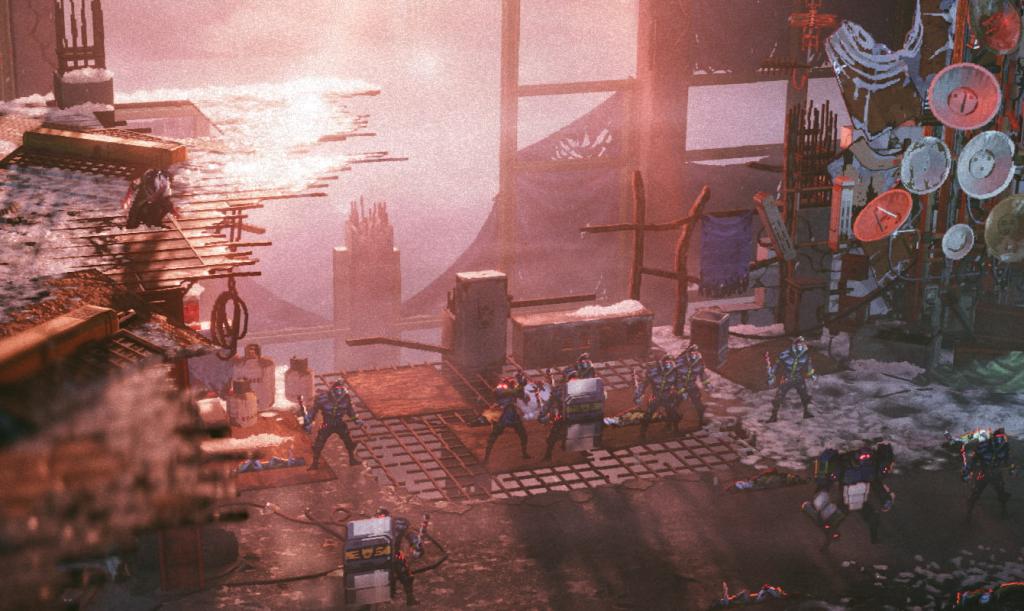
Though combat is action-packed and fun, it has its issues. Only a set number of enemies will fight you at a time, with any excess foes hanging out in the background, politely waiting their turn. On multiple occasions, I struggled to discern which enemies were actually in the fight, leading to me swinging my baton wildly in the air as I thought I was throwing hands (or, in this case, sticks) with a bad guy that wasn’t actually there. Though not totally disruptive to my gameplay experience, it did lead to a few failed fights and frustrating respawns.
Despite REPLACED’s glaring issues, it’ll sink its teeth into you. The narrative’s got bite with plenty of twists and turns, and the world-building, which is told through the game’s collectibles system and minor dialogue options, is enthralling. As you progress in the game, REACH discovers more and more about what the A.I. actually is and the reason behind its creation. REPLACED almost feels like a detective story at times, and the game’s intense sound effects and synth-driven soundtrack play incredibly well into the “dark cyberpunk thriller” genre that Sad Cat set its targets on in development.
At the core of it all, REACH’s transformation is one of the game’s strongest throughlines, evolving in ways that feel both unsettling and deeply human. Supporting characters are morally complex, and REACH’s interactions with them blur the line between man and machine—both internally and externally. It’s all an incredibly intriguing thought-experiment of a narrative, especially now, when A.I. is at the forefront of many headlines and cultural discussions.
Tack side quests, mini games, and moments of cheeky humor onto all of that, and you’ve got a game that’s hard not to recommend, even with all of its flaws.


