


No Rest for the Wicked is, like the Navidson’s home in House of Leaves, much larger than it seems. The first act of the game (and a juicy chunk of postgame) is available right now in Early Access over on Steam, but the longer I play, the more I discover. The more I discover, the more I wish I’d known before undertaking the journey in the first place. These tips should help you through the game’s somewhat brutal early game and beyond.
Level your stamina
Stamina, despite recent buffs via hotfixes, is a crucial resource. Rolling, blocking, and now even parrying require it, and if you run out when facing down a foe you’re going to get slapped around a bit. Leveling stamina, even just two or three times works wonders in the early game for smoothing out the combat experience by letting you act a bit more aggressively.
Don’t skip over resources
Mushrooms and herbs, specifically, are your lifeline in the early game. You aren’t allotted healing items automatically like you are in say, Dark Souls, relying instead on food you find or cook yourself. Your starting recipe for Mushroom Soup relies on these plants, and heals 35 HP. If you’re dashing along and neglect to pick up enough ingredients to keep your bottomless pit of a player character healed up, you’ll run out and have to resort to farming some. I was always running low on Artemisia herb, so be sure you grab it whenever you spot some.
It’s also worth it to chop down some pine trees and collect copper ore whenever you have the required tools on hand. You’ll need these later to upgrade craft and trade booths in Sacrament.
Repair your tools before they break
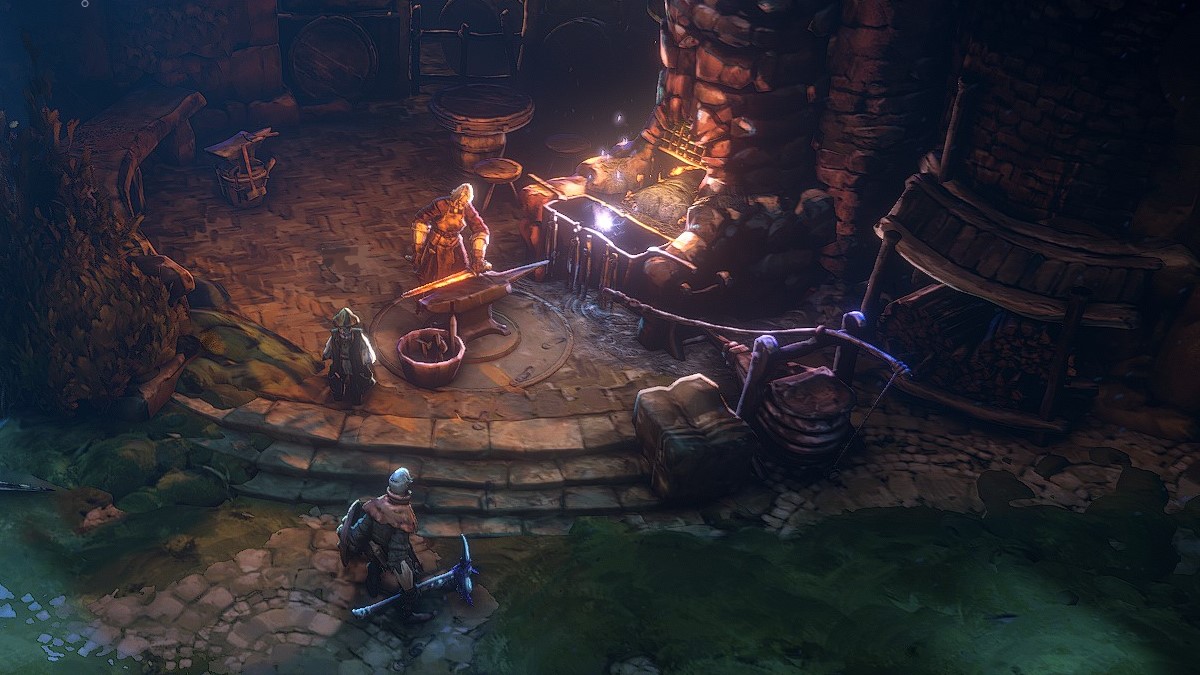
On the note of gathering resources, if you let a shiny new tool you just bought like an iron axe break, you’re going to have to buy a new one. You can spot if one of your gathering tools is about to break by glancing to the bottom right of the screen – a yellow-to-orange toolbox icon will alert you if one or more of your items is approaching disintegration-levels of damage. Luckily, these can be repaired at the blacksmith like anything else.
Experiment with Enchantment (sparingly)
Once you’ve made your way to Sacrament, immediately following the game’s first boss, you’ll have access to a vendor named Eleanor. For a price, she can modify your items in various ways, including bumping their rarity on one or more levels for a mere silver piece.
Enchantment can be tempting, and it has its benefits – boosting your items’ rarity means passive affixes that boost stats. But it comes at the cost of customization, since you’ll lose out on gem and rune slots in the process. Cursed, or “purple,” items, come with a meaty negative affix to balance their stronger positive ones. There’s no guarantee that Eleanor won’t scuff an item by bumping it all the way to Cursed from Common, but it can be a good way to roll for better loot.
Infuse, Infuse, Infuse
Eleanor has a safer way to boost item’s power in the form of infusions. This is simply the process of slotting your found or purchased gems into weapons and armor to grant them effects. Focus Regeneration, Elemental Damage, and Resistances to blights are just a few of the properties gems can grant. Like Diablo, the effect of any given gem comes from the piece of gear it’s infused into, so make sure you experiment and put them to good use.
Extract Runes from weapons you don’t want
Eleanor is back for one last piece of advice: if you’re going to sell a weapon, take a look at its runes first. If there’s one that seems even a little interesting, extract it at her shop. It’ll destroy the weapon in the process, but you’ll stockpile a collection of useful runes for use in weapons you’d like to try out later.
Sometimes, Common rarity items are best
Your goal in No Rest for the Wicked isn’t to deck your character out in the rarest armor possible, it’s to make your build function. And just about any build would crumble under two or more cursed affixes, some of which can reduce your health by a whopping 25%. So instead of chasing rare loot, consider customizing the common items in your collection instead. Common items have four gem slots and four rune slots, meaning they can be fine-tuned to your liking at the expense of a few random attributes.
Don’t get (too) aggressive
Unlike Diablo, an obvious inspiration, No Rest for the Wicked’s combat is reactive. Meaning, you aren’t walking up to three or four enemies at a time and wiping the floor with them – rather, you’re waiting for them to perform their predictable moves and waiting for opportunities to punish. Healing items are a resource, and not getting hit is the best way to “farm” them. If you rely on counterattacks rather than mashing forward and getting whittled down, you’ll progress much faster in the long run.

Buy a house as soon as possible
When you’ve milled around Sacrament a while and progressed the campaign to a certain point, you’ll be able to buy your very own home. The cheapest option is still a hefty 20 silver, but it comes with benefits too good to ignore. First, you can jam it full of chests for storing the dozens of resources, consumables, and materials you pick up on your journeys. You can also cook inside it and place crafting benches of your own. But really, it’s just a great place to horde items, and any of the available offerings are a far cry more convenient than traipsing up to the shared “community” chest whenever you’re overburdened.
Revisit past areas often
Whether for bounty completions or resources, revisiting old areas is going to become necessary at one point or another. Lucky for you, this means replenished loot pools, new enemies with greater experience payouts, and brand-new passages to uncover. The world of NRFTW is a more dynamic one than you might realize, and even the starter zone of the Shallows becomes a treacherous foray into the unknown once you’ve made progress into other areas of the game. Old zones are a great chance to snag some extra experience while stocking up on ever-diminishing supplies.


